
1984 by George Orwell
Who didn't read this novel at some point during school? It's even better as an adult. According to the back of the book:
1984 has come and gone, but George Orwell's prophetic, nightmarish vision in 1949 of the world we were becoming is timelier than ever. 1984 is still the great modern classic of "Negative Utopia" - a startlingly original and haunting novel that creates an imaginary world that is completely convincing, from the first sentence to the last four words, "He loved Big Brother." No one can deny this novel's power, its hold on the imaginations of whole generations, or the power of its admonitions - a power that seems to grow, not lessen, with the passage of time.
I loved this book all over again. I won't get into politics, but it is amazing how much closer we have come to this story. Though we are not yet required to openly profess love for our leaders, we are monitored closely. Very scary.
Are You There God? It's Me, Margaret. by Judy Blume
I read this book when I was a kid. Somehow, the only thing that I remembered about it was the talk about periods and who had gotten theirs. We read this book in “book club” (really a group of friends who get together to discuss sex and drink wine) a while back. It's mostly about religion, or the lack of having a religion. I find it interesting that I missed this as a kid. Anyway ...
Margaret Simon, almost twelve, likes long hair, tuna fish, the smell of rain, and things that are pink. She's just moved from New York City to the suburbs, and she's anxious to fit in with her new friends, so when they form a secret club to talk about boys, bras, and getting their first periods, Margaret is happy to belong. But none of them can believe Margaret doesn't have a religion. And Margaret can't tell them the truth: that she can talk to God anyway, about everything that's on her mind - including Philip Leroy, the best-looking boy in sixth grade.
I enjoyed reading this book again (for the whole four hours that it took me), mostly b/c of Margaret’s curiosity about the various types of religion and how and where she fits in. If I had a daughter, I’d definitely recommend that she read this one.
Half of a Yellow Sun by Chimamanda Ngozi Adichie
I’m extremely attracted to books like this. I’d also recommend “What is the What.” Both will floor you.
With effortless grace, Chimamanda Ngozi Adichie illuminates a seminal moment in African history: Biafra’s struggle to establish an independent republic in southeastern Nigeria during the late 1960s. We experience this tumultuous decade alongside five unforgettable characters: Ugwu, a thirteen-year-old houseboy who works for Odenigbo, a university professor full of revolutionary zeal; Olanna, the professor’s beautiful young mistress; and Richard, a shy young Englishman infatuated with Olanna’s willful twin sister Kainene. Half of a Yellow Sun is a tremendously evocative novel of promise, hope, and the disappointment of war.
It’s also illuminating, speaking as an American who has never experienced war close up. I cannot imagine living the lives of any of these people. And yet people do; everyday. I hope never to be one of them.
The Welsh Girl by Peter Ho Davies
Set in the stunning landscape of North Wales just after D-Day, Peter Ho Davies’ profoundly moving first novel traces the intersection of disparate lives in wartime. When a POW camp is established near her village, seventeen-year-old barmaid Esther Evans finds herself strangely drawn to the camp and its forlorn captives. She is exploring the camp boundary when the astonishing occurs: Karsten, a young German corporal, calls out to her from behind the fence. From that moment on, the two foster a secret relationship that will ultimately put them both at risk. Meanwhile, another foreigner, the German-Jewish interrogator Rotherham, travels to Wales to investigate Britain’s most notorious Nazi prisoner, Rudolf Hess. In this richly drawn and thought-provoking work, all will come to question where they belong and where their loyalties lie.
I liked this book. Because I came from a small town, though not as small as this one by any stretch of the imagination, I related to Esther. I imagine that she’d describe this period of her life as one of the most exciting … something that she’d talk to her grandkids about, but not her children.
Empire Falls by Richard Russo
There’s a reason why this one won the Pulitzer Prize. It is outstanding. This book perfectly describes how it feels to feel stuck. It also makes you realize that you don’t have to be.
Miles Roby has been slinging burgers at the Empire Grill for 20 years, a job that cost him his college education and much of his self-respect. What keeps him there? It could be his bright, sensitive daughter, Tick, who needs all his help surviving the local high school. Or maybe it’s Janine, Miles’ soon-to-be ex-wife, who’s taken up with a noxiously vain health-club proprietor. Or perhaps it’s the imperious Francine Whiting, who owns everything in town – and seems to believe that “everything” includes Miles himself. In Empire Falls, Richard Russo delves deep into the blue-collar heart of America in a work that overflows with hilarity, heartache, and grace.
The Worst Hard Time by Timothy Egan
The dust storms that terrorized America’s High Plains in the darkest years of the Depression were like nothing ever seen before. In the Worst Hard Time the Pulitzer Prize winning New York Times journalist and author Timothy Egan tells the epic story of this environmental disaster and its impact on the communities stricken with fear and choked by dust in the “dirty thirties.”
John Steinbeck gave voice to those who fled the Dust Bowl in his masterpiece, The Grapes of Wrath. This is the story of those who stayed and survived – those who, now in their eighties and nineties, will soon carry their memories to the grave – and it is an extraordinary story of endurance and heroism. In an era that promises ever-greater natural disasters, The Worst Hard Time is a powerful cautionary tale about the dangers of trifling with nature.
FYI: There is a History Channel program about this disaster airing this weekend, I think.
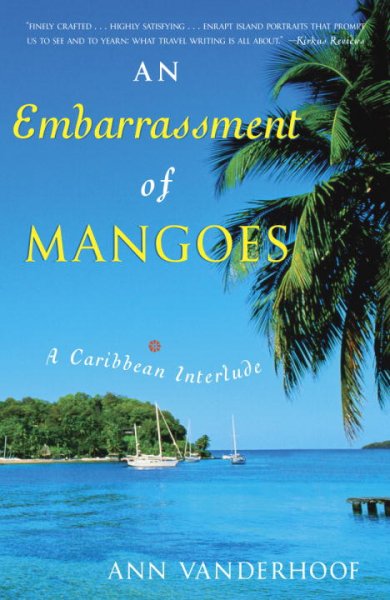 Last night I got to host book club and An Embarrassment of Mangoes was this month's selection. I'm still about 30 pages from the end, but I have completely enjoyed it. Basically it's about a couple who took a two-year sabbatical to move onto a 42-foot sail boat and travel through the Caribbean. Each chapter ends with a recipe for the various types of food that they ate during their travels. Tonight for dinner I plan to make Bahamian mac and cheese on page 82.
 In keeping with the Caribbean theme, I made Caribbean beef stew for the book club dinner. I found this recipe in my new slow cooker book. This is the third recipe that I've tried from this book. So far, each of the dishes I've made have come out tasting pretty bland, but that's easily corrected by tossing in a little extra this and that at the end. This dish seemed to get good reviews from the girls, so here's the recipe.


